Evidence & clinical communication
A picture can help.
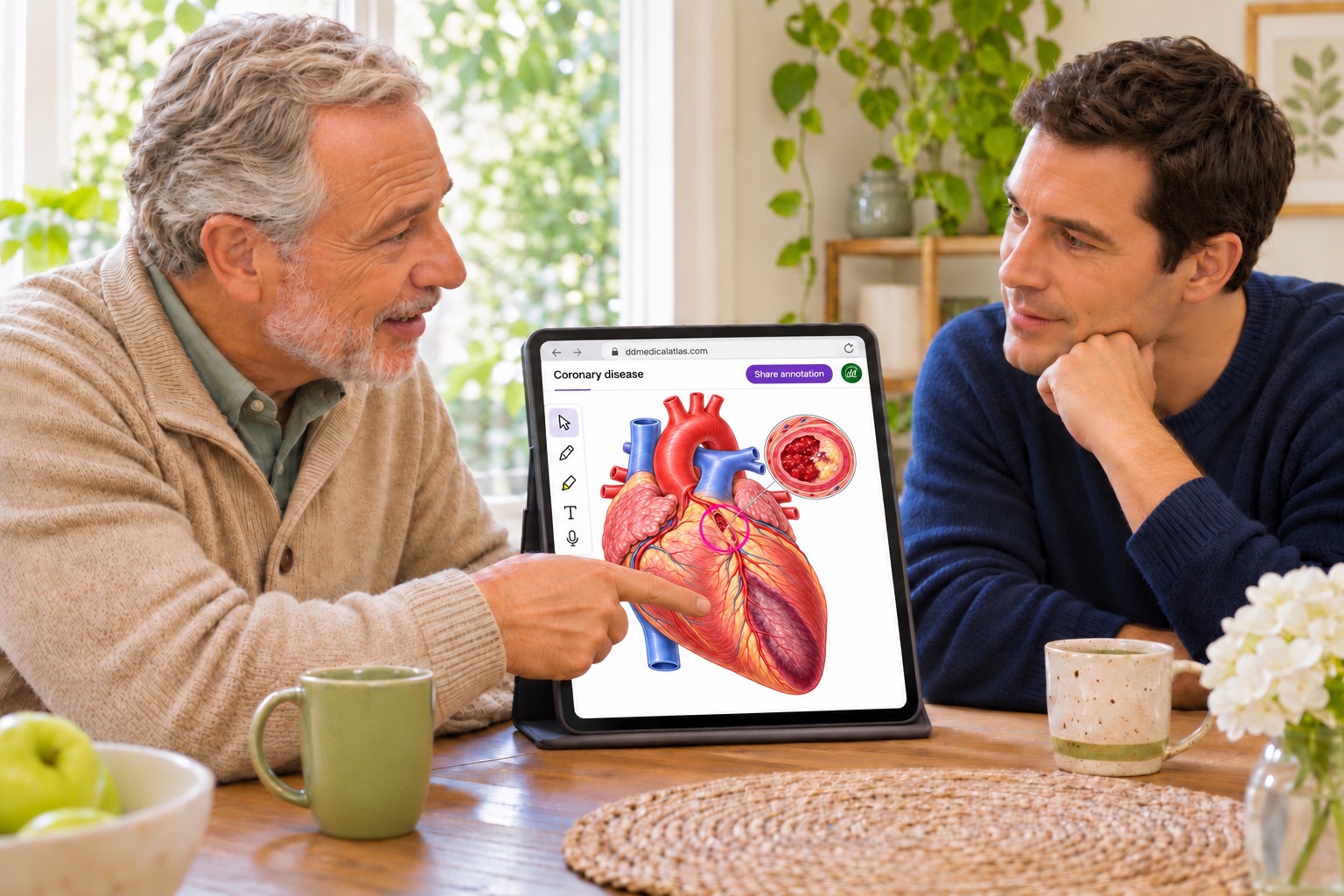
A conversation makes it personal.
Medical illustrations can support healthcare professionals as they explain disease, treatment and procedures. The most defensible benefits concern understanding and recall. Other outcomes depend on how visuals are designed and used.
Focused evidence review · 6 November 2026
This is a targeted narrative review, not a systematic review or a clinical evaluation of DD Medical Atlas. The studies concern varied pictures, pictograms and decision aids; their findings cannot be treated as measured results for this app, personalised annotations or 3D-rendered artwork. The labels below describe relevance and limitations, not formal GRADE ratings.
Download evidence infographic (SVG) · Download consultation infographic (SVG)
What can we reasonably say?
Direct evidence · variable effectsUnderstanding & recall
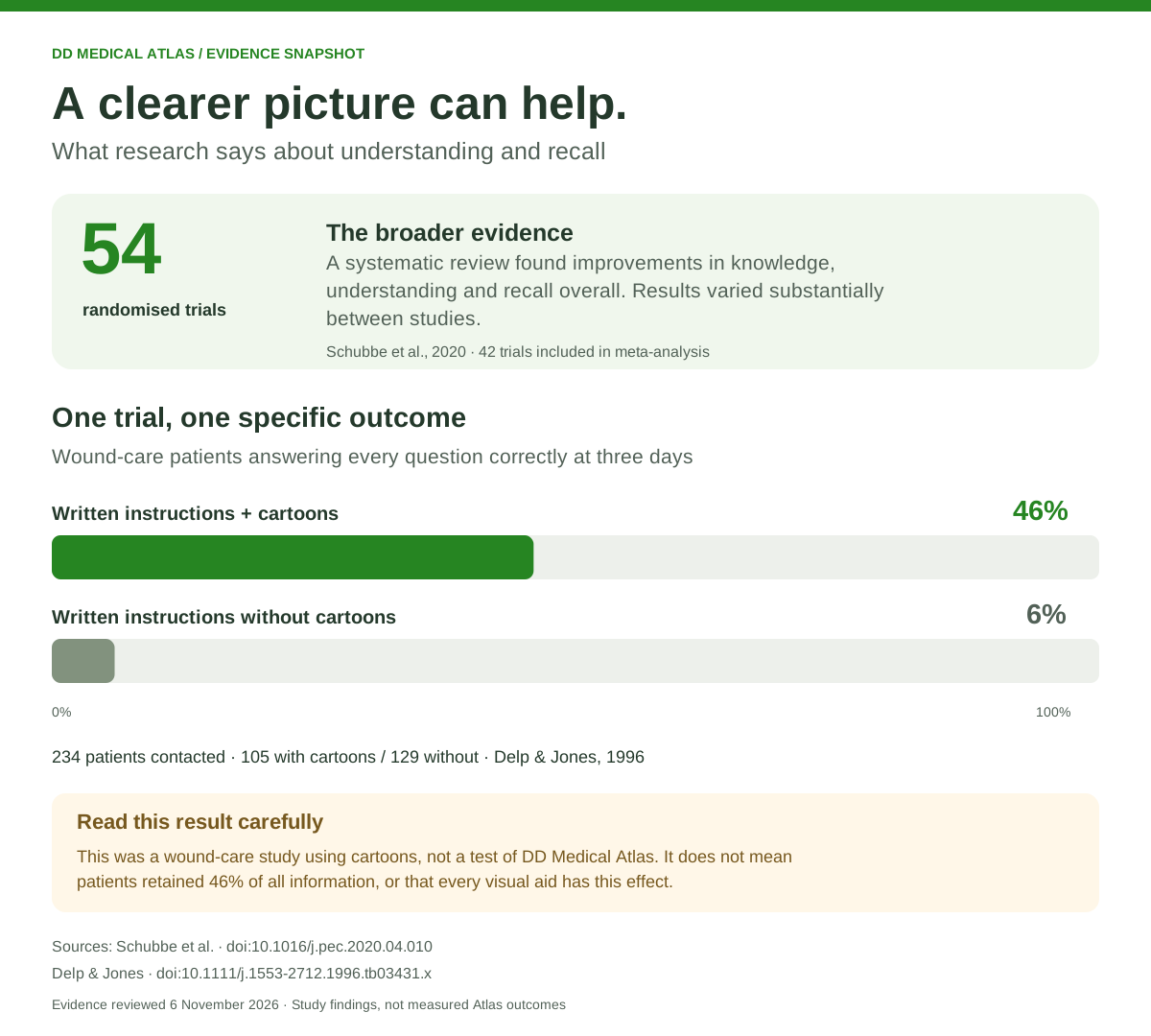
The 2020 review found moderate overall improvements with pictorial health information, including larger knowledge gains in lower-health-literacy groups. Substantial heterogeneity means there is no single reliable percentage benefit for every consultation. [1]
The wound-care trial in the infographic contacted 234 patients at three days. Its outcome was answering every wound-care question correctly, not “percentage of information retained”. [2]
Short-term benefit ≠ lasting retentionRemembering after the visit
In a 144-patient discharge-instruction trial, pictographs improved immediate recall, but there was no clear recall advantage at one week. Satisfaction with how understandable the instructions were was better at one week. [3]
Take-home images are a useful way to revisit an explanation, but durable recall should be measured rather than promised.
Evidence from structured conversation aidsParticipation & feeling involved
A breast-cancer surgery trial involved 571 patients across 16 surgeons. A picture-and-text conversation aid improved knowledge, decision process and observed and patient-reported shared decision making versus usual care. [4]
This supports a collaborative approach, but does not isolate the effect of pictures alone. It does not establish that an annotated anatomy image makes every patient feel included or ask more questions.
Potential support · not a universal languageLanguage & literacy barriers
A medication-instruction review supports some visual formats for people with limited English proficiency. Transfer to disease and procedure illustrations is indirect. [5]
In a validation study involving 250 older adults with limited English proficiency, only 14 of 52 pictograms met both validity criteria. Images can be misunderstood. [6]
Use clear explanations, appropriate translated information and interpreter support where needed; check what the patient understood. [10]
No general time-saving claimConsultation time
The 2024 Cochrane decision-aid review found no clear difference in consultation duration when aids were used beforehand. Using aids during the consultation added about 1.5 minutes on average (95% CI 0.79–2.20; eight studies). [7]
Decision aids are broader interventions than illustrations. Faster explanation, fewer repeat questions or reduced follow-up work remain hypotheses for an Atlas evaluation.
Insufficient evidenceLitigation
A systematic review found insufficient empirical evidence that shared decision making or decision-support interventions reduce malpractice litigation. It included only five heterogeneous studies and searched through January 2014. [8]
This focused search did not identify direct evidence that annotated medical illustrations reduce claims. Better communication is a worthwhile aim; “reduces litigation” is not a substantiated product claim.
Make room for two-way conversation
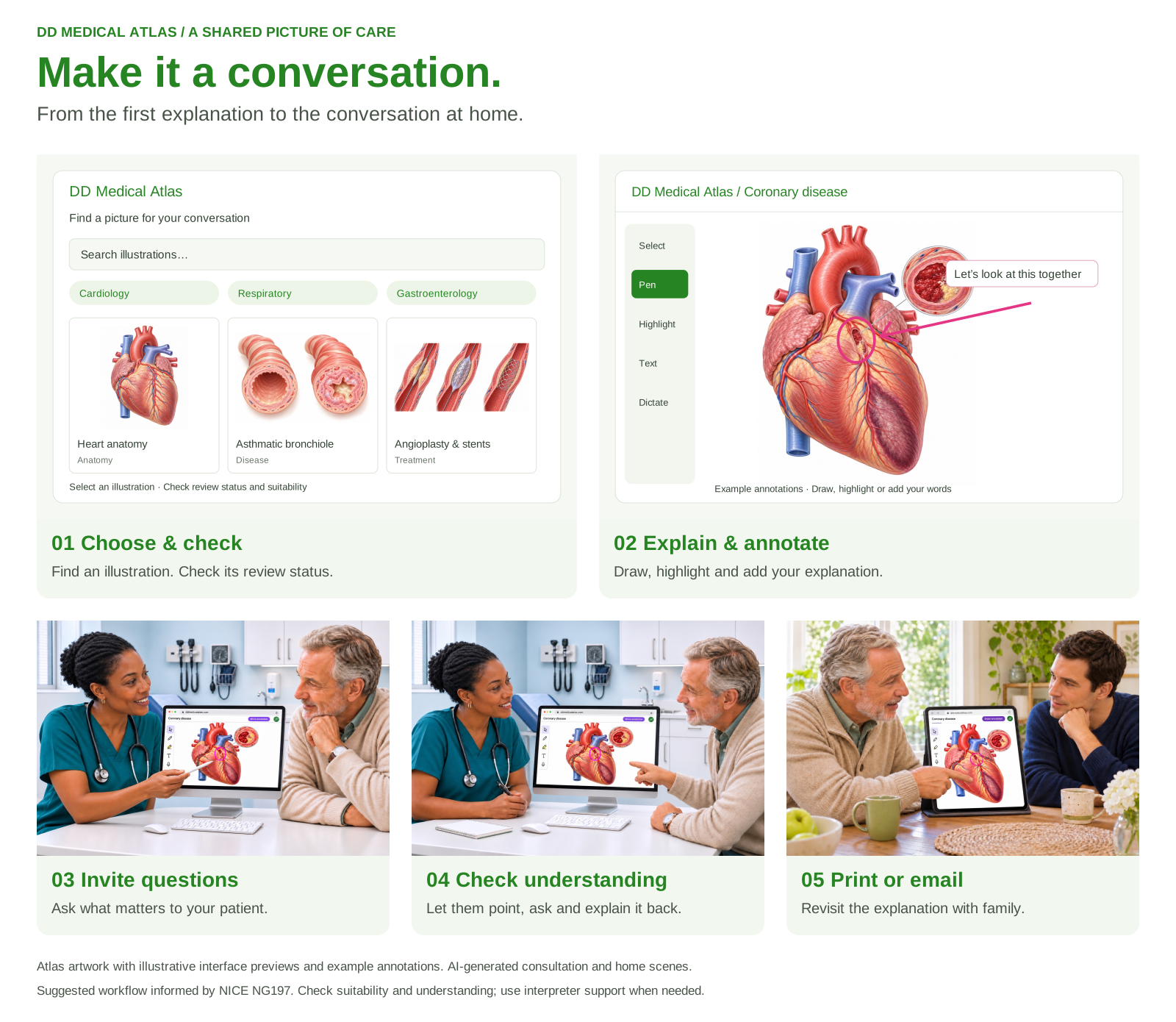
Invite the patient to point to the image, explain their concerns and ask questions. Use their words in annotations, then ask them to describe the explanation back. This is a practical application of shared-decision-making guidance, not a demonstrated Atlas effect. NICE recommends inviting questions, checking understanding and offering information to take away. [9]
Choose & check
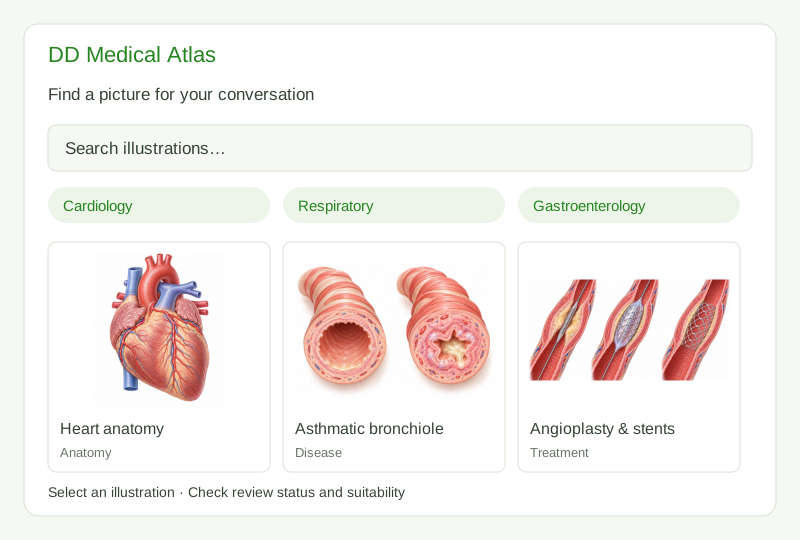
Find the right illustration. Check its review status.
Explain & annotate
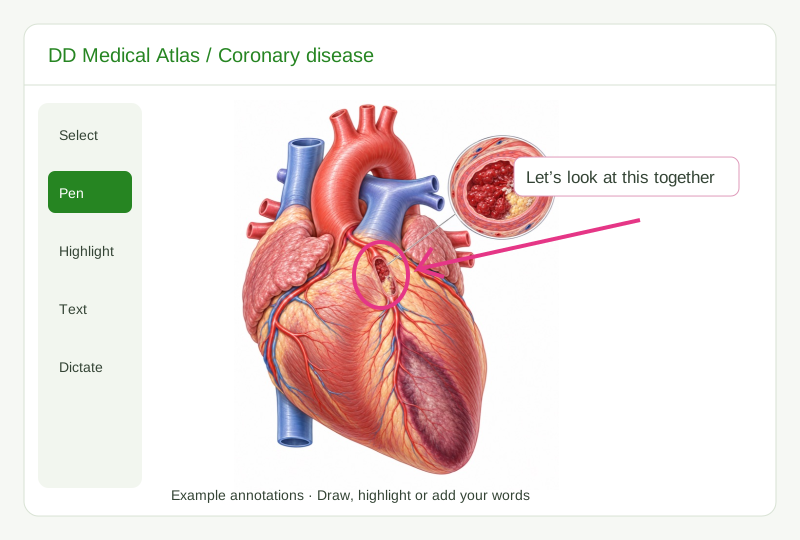
Draw, highlight and add your explanation together.
Invite questions
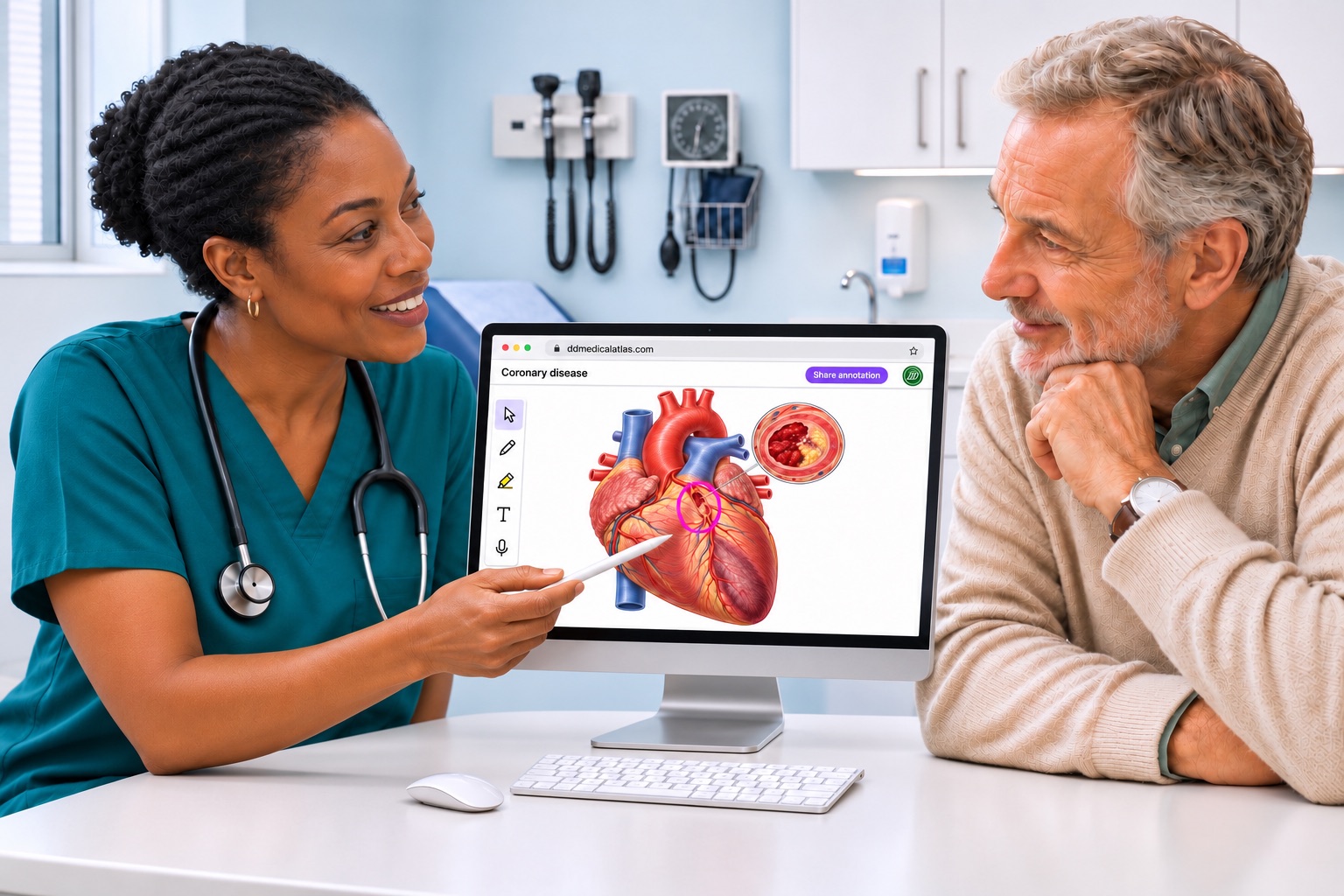
Show the picture. Ask what matters to your patient.
Check understanding
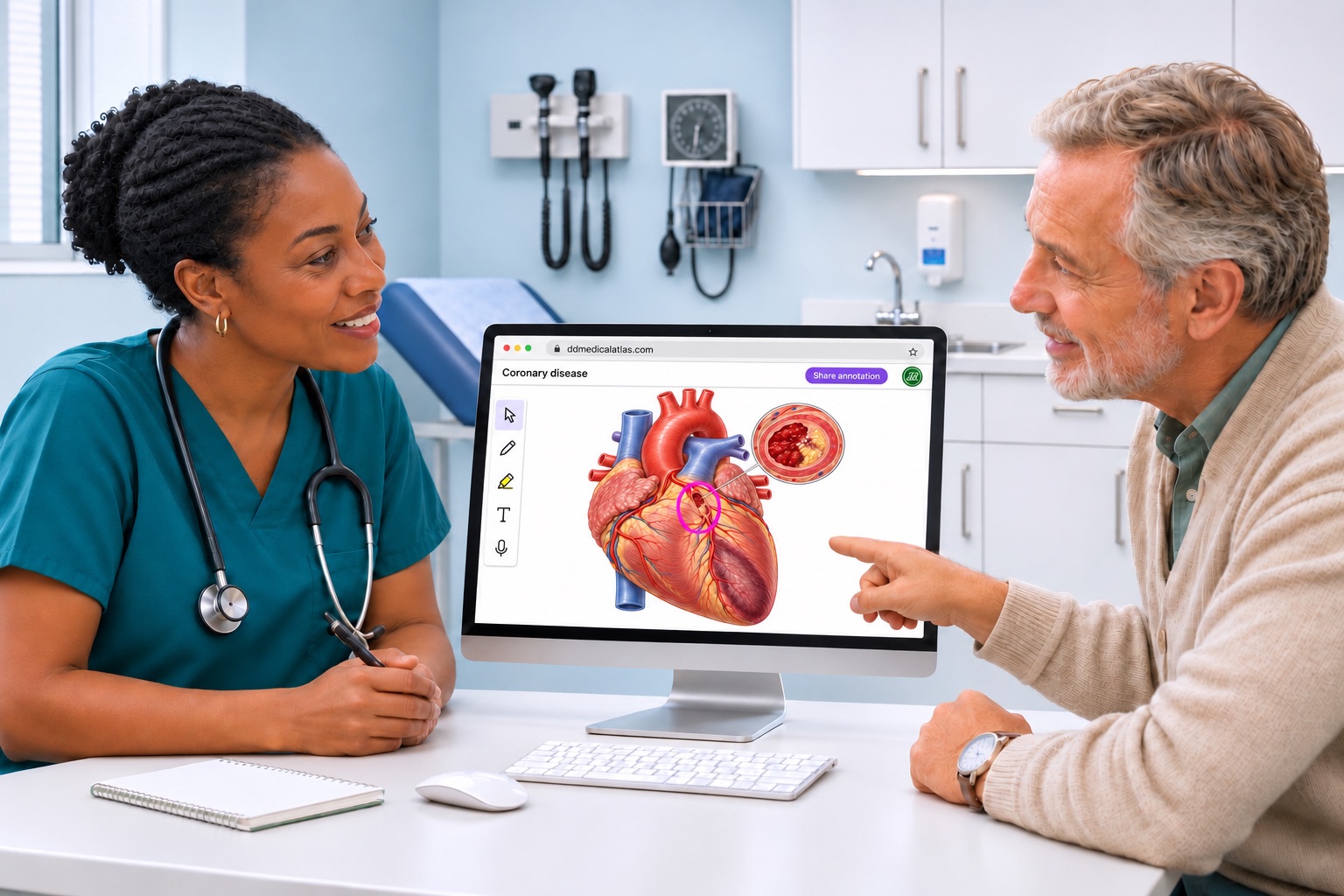
Let the patient point, ask and explain it back.
Print or email
Take the explanation home. Revisit it with family.
Atlas artwork with example annotations and interface previews. Consultation and home scenes are AI-generated illustrations of the workflow.
What “clinically reviewed” means here
Review status belongs to a specific illustration version. Where the app shows a current “Clinically Reviewed” badge, it identifies the specialist, review date and supporting references. Production approval is not specialist clinical sign-off. We do not describe the whole catalogue as peer reviewed, and a reviewer’s sign-off does not validate later personal annotations.
What DD Medical Atlas should evaluate next
A prospective comparison with usual explanations could measure immediate understanding, recall after one to two weeks, patient-reported involvement, questions asked, consultation length and later clarification contacts. Record language needs, interpreter use and health literacy; assess whether patients can interpret the images as intended. These are proposed evaluation outcomes, not completed research.
Sources & review scope
We searched web-indexed PubMed, journal, Cochrane, NICE and GMC sources for pictorial health information, clinical recall, visual conversation aids, language barriers, consultation duration and litigation. We prioritised systematic reviews, randomised trials and professional guidance. Selected evidence spans 1996–2024, with current guidance checked in November 2026. Some findings were available only as abstracts; no formal risk-of-bias assessment or exhaustive database search was performed. Older studies, different visual formats and settings limit generalisability.
- Schubbe et al. (2020). Using pictures to convey health information: systematic review and meta-analysis. 54 randomised trials; 42 included in meta-analysis.
- Delp & Jones (1996). Communicating information to patients: cartoon illustrations and emergency-department wound-care instructions. Academic Emergency Medicine, 3:264–270.
- Hill et al. (2016). Automated pictographic illustration of discharge instructions with Glyph: impact on patient recall and satisfaction. JAMIA, 23:1136–1142.
- Durand et al. (2021). What matters most: randomised trial of breast-cancer surgery conversation aids across socioeconomic strata. Cancer, 127:422–431.
- Sharko et al. (2022). Strategies to optimize comprehension of numerical medication instructions: systematic review and concept map.
- Malhotra et al. (2021). Validation of pharmaceutical pictograms among older adults with limited English proficiency.
- Stacey et al. (2024). Decision aids for people facing health treatment or screening decisions. Cochrane review.
- Durand et al. (2015). Can shared decision-making reduce medical malpractice litigation? Systematic review.
- NICE NG197. Shared decision making: recommendations on discussion, questions, understanding and take-home information.
- General Medical Council. Decision making and consent: supporting understanding and communication, including interpreter or translation support.
← Return to DD Medical Atlas